
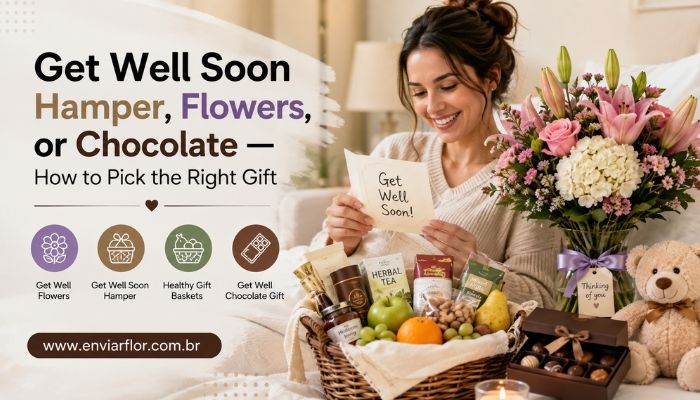
Nobody likes hearing that a friend, coworker, or family member is stuck in bed, just out of surgery, or going through one of those miserable recovery weeks. And almost every time, the urge to help runs into the same question: what do you actually send? A text feels thin. Showing up in person isn't always possible. That's where a well-chosen get well soon gift comes in — something that arrives at the door and says, without needing a single word, that someone is thinking of them.
This isn't a generic "10 gift ideas" list. It's a way of reasoning through it: surgery, a bad flu, a longer procedure, or just a rough week each call for a different kind of gift. Here's how to work through it.
Get well flowers: when a bloom says it best
There's a reason hospitals and recovery rooms almost always have a vase tucked in a corner somewhere: a splash of color in a still room lifts the mood more than people expect. Get well flowers remain the most traditional choice for good reason. They ask nothing of the person receiving them — no cooking, no appetite required, no effort — they simply sit there, looking good, reminding the person that life outside is still moving.
Worth thinking about the setting: hospitals often restrict heavily scented flowers or loose pollen (allergies and immunocompromised patients are the reason), so a more discreet arrangement — orchids or low-pollen cut flowers — tends to land better than a big, perfumed bouquet. For a recovery at home, the rules loosen up and you can go bigger on color and size.
Get well soon hamper: comfort in one package
If flowers speak to the eye, a get well soon hamper speaks to the whole day. It bundles several small kindnesses into one package — something to snack on, something warm to drink, maybe a comfort item — which is why it's usually the pick for people who want to deliver more than a pretty gesture; they want to deliver practicality.
A well-put-together hamper for this moment avoids overdoing it. The goal isn't to impress with quantity — it's to get right what the person will actually use during recovery: easy-to-eat items, nothing that needs real preparation, and nothing that clashes with possible dietary restrictions (post-surgery often comes with specific food guidance). That's why a balanced get well soon hamper — not all sweets, not overly "clean" either — tends to work for most people.
Healthy gift baskets: care that also nourishes
Over the past few years, one specific type of gift has gained ground: healthy gift baskets. The logic is simple — if someone is recovering, the gift should help that process along, not work against it. Fresh fruit, nuts, teas, and lower-sugar options are especially sought out by people on extended bed rest, recovering from surgery, or who simply prefer lighter gifts.
This type of basket also solves a common problem: dietary restrictions. Not everyone can eat chocolate or gluten, and a get well soon gift basket built around fruit and natural items is usually a safer bet when you don't know someone's preferences (or limitations) well. It works equally well for someone on a doctor-recommended diet and for someone who just likes eating cleanly day to day.
Get well chocolate gift: the treat nobody turns down
Not everything about recovery needs to be sensible. Sometimes what a person wants most is a simple moment of indulgence — and that's where a get well chocolate gift comes in. Unlike the healthy basket, this is the gift of pure comfort: a small pleasure that breaks up the monotony of days spent on the couch or in bed.
Chocolate works well as a companion gift — paired with flowers, say — or as a standalone gift for someone you know will appreciate a sweet treat more than a large basket. For someone recovering from something more serious, a good-quality chocolate gift in a modest amount usually lands better than a giant box: the gesture matters more than the volume.
How to choose based on who's receiving it
Instead of asking "what's the best get well soon gift" in the abstract, it helps to think by profile:
- Recovering from surgery or a medical procedure: stick to light items with no dietary restrictions, and skip strong scents if delivering straight to a hospital. A healthy basket or a discreet flower arrangement is usually the safest call.
- Flu, cold, or a short rough patch: more freedom here. A comfort-focused hamper, or even chocolate, helps lift the mood during what's usually a short stretch.
- A coworker or acquaintance: flowers or a mid-sized hamper communicate care without feeling overly personal — the right register for a professional relationship.
- Close family or a good friend: this is where you can combine things — flowers plus chocolate, or a more complete hamper — since the closeness allows for a more generous gesture.
What to write (and what to skip) on the card
One detail that makes a real difference and costs nothing: the card that comes with the gift. A generic "get well soon" does the job, but one personal line — a specific memory, an inside joke, or simply "thinking of you" — tends to matter more than the gift itself. It's also worth skipping comments about how serious the situation is or questions about prognosis; the card's job is to comfort, not to open space for worry.
FAQs:
1. Can I send flowers directly to a hospital room?
Usually yes, but many hospitals restrict pollen and strong fragrance, especially in units like the ICU or oncology. If you're not sure about the rules at that specific location, a safer option is to time delivery for the person's home after discharge.
2. What's the difference between a regular get well soon hamper and a healthy gift basket?
A traditional hamper usually mixes comfort items — sweets, snacks, tea — with no particular nutritional focus. A healthy gift basket prioritizes fruit, nuts, and lower-sugar options, making it a better fit for someone following dietary guidance during recovery.
3. Is chocolate an appropriate gift for someone who's sick?
It depends on the situation. For colds, flu, or lighter recoveries, generally yes — in a moderate amount. For someone under a specific dietary restriction (diabetes, strict post-surgery guidance), it's best to check with the person or a family member before sending.
4. Is it better to send one type of gift, or combine categories — flowers, hamper, chocolate?
There's no fixed rule — it depends on how close you are and what you know about the person. Combinations make sense for closer relationships; one well-chosen gift is usually enough, and more appropriate, for coworkers or acquaintances.